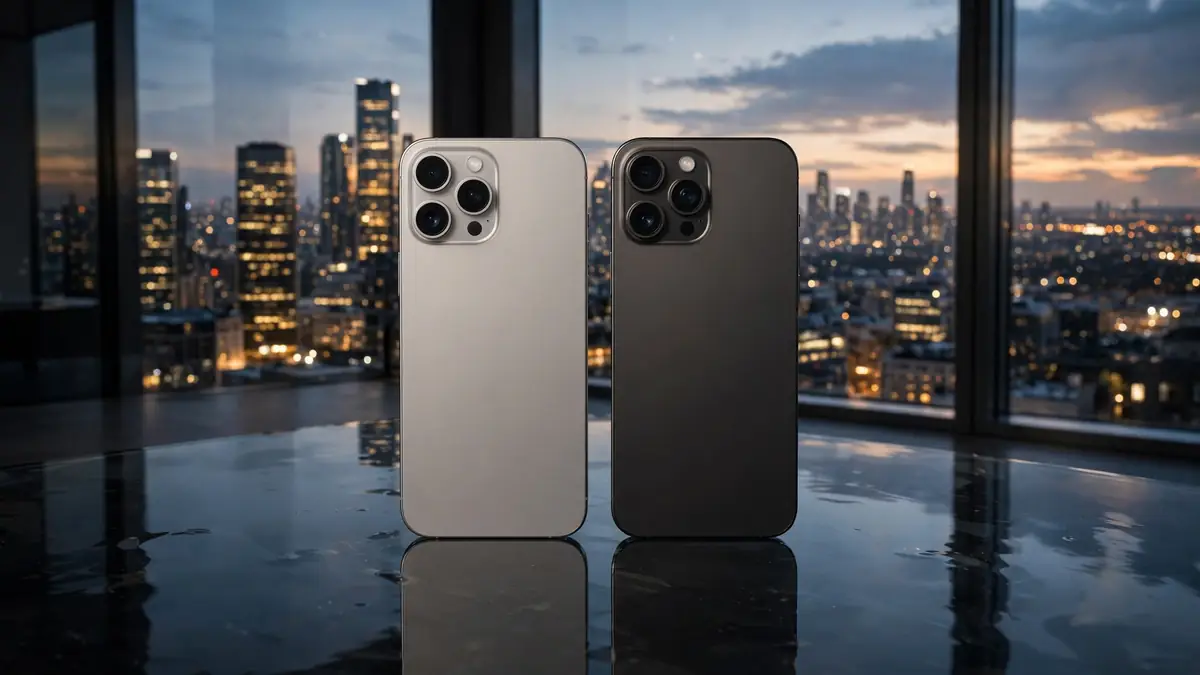
September has become the most consequential month on the smartphone calendar, and 2026 was no exception. On September 9, Apple unveiled the iPhone 18 Pro line-up, while Samsung's Galaxy S26 Ultra had already been setting the benchmark since its February debut. Seven months apart, both phones now sit at the top of their makers' ranges — and both are asking buyers for well over a thousand dollars or pounds. The question is no longer which one is "the best phone", but which one is the best phone for you.
This comparison is based on announced specifications, published expert analysis, and pricing reported in September 2026. Neither phone was tested hands-on for this piece — instead, we weigh what the manufacturers have confirmed and what independent reviewers have reported, so you can decide before you buy.
The iPhone 18 Pro: Apple's 2nm bet
The iPhone 18 Pro is built around Apple's A20 Pro chip, the first smartphone processor manufactured on a 2-nanometre process, paired with a triple 48-megapixel rear camera system whose headline feature is a new variable-aperture main lens. Up front sits an 18-megapixel camera, and the phone runs iOS 27 with the latest Apple Intelligence features. The frame remains aluminium, but Apple has moved to Ceramic Shield 2 glass that it claims offers noticeably better drop resistance than the previous generation.
At 6.3 inches, the iPhone 18 Pro is noticeably smaller in hand than its Samsung rival — a deliberate choice that will delight anyone tired of ever-larger slabs. Both phones carry an IP68 rating, so dust and water resistance is a non-issue on either side. Apple positions the Pro line against the $1,199 price band for the Pro Max tier, and September reports noted promotional and trade-in activity across carriers as brands fought for the same pool of upgraders in a shrinking market.
Where Apple continues to differentiate is the ecosystem. As analysts covering the September launch window noted, iOS app optimisation, deep integration with Apple Intelligence, and the way iPhones, Macs, AirPods and Apple Watches share data create advantages that a spec sheet cannot capture. If your household already runs on Apple, the iPhone 18 Pro's value proposition extends well beyond its silicon.
The Galaxy S26 Ultra: Samsung's everything phone
Samsung's Galaxy S26 Ultra arrived in February 2026 and has had half a year to prove itself. It sticks with a titanium frame, Corning Gorilla Armor 2 on the front and Gorilla Glass Victus 2 on the back, with edges slightly more rounded than last year's model. The 6.9-inch body makes it a big phone by any measure, but the rounded edges reportedly make it a little easier to hold than its predecessor.
The headline hardware story is the 200-megapixel main camera — the highest-resolution sensor on any mainstream flagship — and Samsung's genuinely useful Privacy Display feature, which limits viewing angles so shoulder-surfers on trains and planes see less of your screen. Perhaps the most decisive hardware difference of all: the S26 Ultra packs an S Pen slot along its bottom edge. For note-takers and sketchers, a stylus can settle the debate before the spec sheet even enters the conversation.
Samsung's own silicon strategy puts its top-tier chip (alongside the new Snapdragon 8 Elite Extreme Gen 6 powering rivals like the Xiaomi 18 Pro Max) in the same performance conversation as Apple's A20 Pro. Independent coverage of the flagship class has consistently found that real-world performance differences between this year's top chips are minimal for most users — scrolling, multitasking and gaming all feel instantaneous on both.
Head to head: the areas that matter
Design and display
The iPhone is the compact choice at 6.3 inches with Ceramic Shield 2; the Samsung is the maximalist choice at 6.9 inches with titanium and Gorilla Armor 2. Samsung wins outright on screen real estate and the S Pen, while Apple wins for one-handed comfort and pocketability. Both are IP68-rated, so durability basics are covered either way.
Camera
Apple's approach is refinement: three 48-megapixel sensors with a variable-aperture main lens that adjusts physically to light conditions, plus an 18-megapixel front camera. Samsung's is resolution: a 200-megapixel main sensor with deep computational zoom. Which wins depends on how you shoot — Apple's system is widely praised for colour consistency and video, Samsung's for zoom reach and detail in good light. Neither manufacturer has published head-to-head night-mode benchmarks, so treat launch-event camera claims on both sides with healthy scepticism.
The A20 Pro's 2nm process gives Apple a paper efficiency advantage, while Samsung leans on Galaxy AI features baked into One UI. Both phones shipped in 2026 with aggressive on-device AI marketing — transcription, summarisation, photo editing and voice assistance. The practical difference is less about raw speed than about which assistant ecosystem you already use: Apple Intelligence across your Apple devices, or Google/Samsung AI services.
Battery and charging
Both manufacturers promise all-day battery life, but their testing methods differ, so treat the marketing figures as indicative rather than comparable. The broader trend in 2026 is that Chinese flagships such as the Xiaomi 18 Pro Max have pushed battery capacity and charging speeds dramatically — 8,500mAh cells and 100W wired charging are now real — which makes the more conservative charging on both the iPhone and the Galaxy look cautious by comparison.
Price and the market context
Context matters: industry reporting in September 2026 put global smartphone shipments down nearly 14 percent, with the average selling price hitting a record $550. These brands are fighting over a shrinking pie, which is why September produced unusually aggressive promotional pricing, carrier deals and trade-in offers. If you are buying now, shop the deals — the headline price is rarely the price anyone pays.
Who should buy which?
Buy the iPhone 18 Pro if: you are invested in the Apple ecosystem, you want a smaller premium phone, you prioritise video quality and long software support, or you simply prefer iOS.
Buy the Galaxy S26 Ultra if: you want the biggest screen, the S Pen, maximum camera resolution and zoom, or the Privacy Display for working on the move. Android loyalists and anyone who finds 6.3 inches too small should start here.
Meridian's verdict
There is no universal winner — there is a winner for your hand, your ecosystem and your habits. The iPhone 18 Pro is the more refined, more compact, more ecosystem-locked choice; the Galaxy S26 Ultra is the more versatile, more maximalist, more feature-stuffed one. Buy the iPhone if Apple already owns your digital life. Buy the Samsung if you want the most phone for your money and an S Pen in the box, metaphorically speaking. Either way, buy during the September–October promotional window rather than at launch-day pricing.
Sources