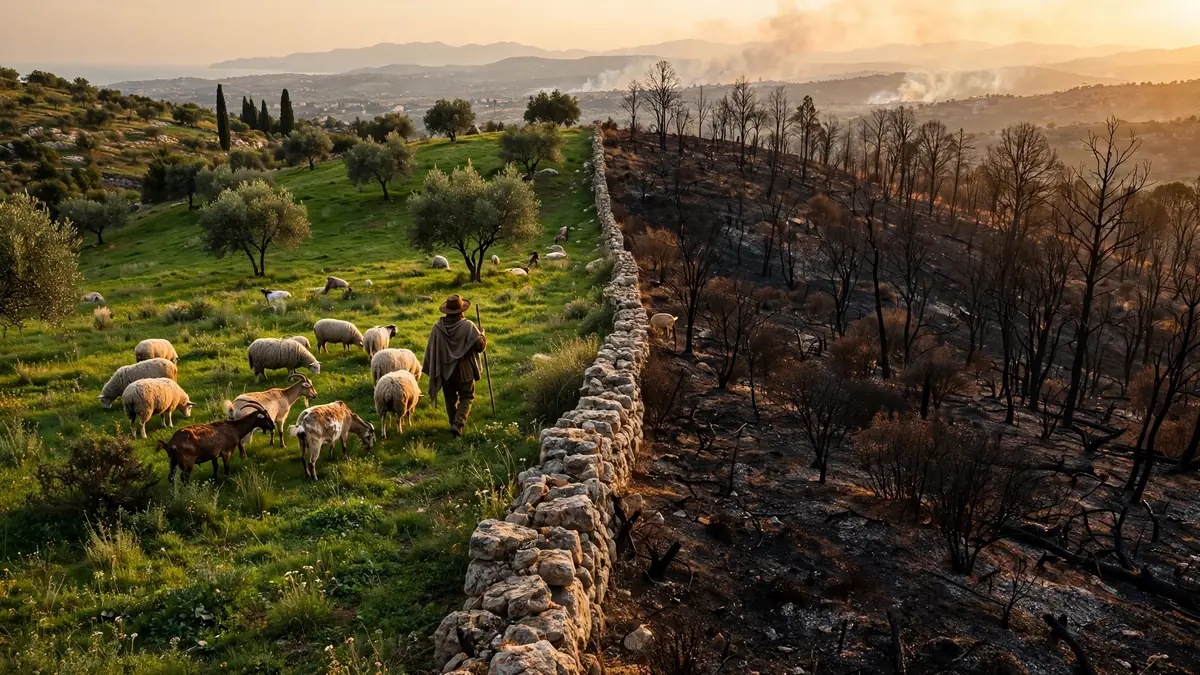
A continent on fire
Europe's 2026 wildfire season is leaving a stark footprint. Through early September, around 650,000 hectares across Europe had been burned by wildfires — more than double the long-term average of the last 20 years, according to data compiled by the Bulletin of the Atomic Scientists. It follows 2025, when nearly 8,000 wildfires scorched more than one million hectares of land in Europe, the worst wildfire year ever recorded on the continent, according to the European Forest Fire Information System.
The official mid-season accounting is sobering. The Global Fire Monitoring Center reported on September 5 that a record-breaking summer saw more than 1,000 wildfires torch some 540,000 hectares of land across the European Union between mid-June and early September — an area more than twice the size of Luxembourg. Four of the EU's 15 largest fires of the last ten years occurred this summer, according to EFFIS data. The total burned area between June 18 and September 2 stands well above the 20-year average, though below the record set in 2025.
The fires were concentrated in the Mediterranean south. In Spain and France, historically destructive blazes burned through around 300,000 hectares this summer. Devastating fires in July surrounded the cities of Bordeaux in France and Madrid and Valencia in Spain, at one point forcing more than 300,000 evacuations. In the Spanish province of Ávila, a fire that broke out on July 22 destroyed more than 42,000 hectares; the Spanish government said it considered the blaze the worst in the country's modern history. Another fire in Andalusia in July led to more than a dozen deaths. A mega-fire that started in France's Gironde region, near Bordeaux, on the same July day consumed 37,000 hectares of forest.
September brought no respite. On the night of September 13, a wildfire broke out near Positano on Italy's Amalfi Coast, spreading fast through dry Mediterranean vegetation above one of the country's most visited coastlines. A landslide triggered by the fire debris closed State Road 163, and by September 15 multiple fire fronts were burning across the broader Amalfi Coast and Sorrento Peninsula, with precautionary evacuations in Agerola. Local officials said the word 'deliberately' was already being used — arson is suspected.
The uneven map
Not every country fared equally. Greece recorded the smallest wildfire-burned area among five southern European countries this summer, according to Minister of State Akis Skertsos, citing data from the European Copernicus/EFFIS monitoring system. As of September 9, Greece had burned 335,230 stremmas of land — a stremma is roughly a quarter of an acre — a figure 30.1 per cent below the country's 20-year average, making Greece both the smallest absolute burned area and the only one of the five to fall below its historical average.
The contrast is striking: Spain recorded burned area 246.6 per cent above its 20-year average, Italy 104.3 per cent above, and France 599.5 per cent above. Portugal came in 13.9 per cent below its own average. The divergence suggests that fire outcomes are not dictated by weather alone — land management, prevention investment and sheer luck all play their part.
A generation that will live with fire
The long-term trajectory is what should worry policymakers most. A September 2026 study reported by The Guardian found that European babies born after 2025 will experience nearly twice as much extreme fire weather over their lifetimes as their great-grandparents born around 1950. The generation born after 2025 faces approximately three additional years of lifetime extreme fire weather compared with those born in 1950 — and in the Mediterranean, the disparity is even starker, with children facing five additional years of exposure unless emissions are rapidly reduced.
The study, led by Rosa Pietroiusti at the Vrije Universiteit Brussel, attributes the rise to 1.4°C of planetary heating from 150 years of fossil fuel use. Europe has warmed at twice the global average rate. For a child born this year in Athens, Seville or Marseille, extreme fire weather will not be an occasional emergency but a recurring condition of life.
The oldest fix: sheep
Amid the ashes, an unlikely solution is getting fresh attention — one that predates the Roman Empire. In the valleys and canyons of central Italy, transhumant shepherd Nunzio Marcelli tends a flock of around 1,500 sheep near Anversa degli Abruzzi. As his animals move across the mountains, they do something no firebreak or water bomber can replicate: they eat the fuel.
'All of this is open because of grazers,' Marcelli said. 'It's the result of an age-old tradition that has kept this territory going for thousands of years.' Transhumance — from the Latin trans, across, and humus, earth — is the seasonal movement of livestock between winter pastures at low altitudes and summer ones on mountain summits. It is a form of extensive grazing in which animals cover wide swathes of land at low intensity, clearing the tall grasses and shrubbery that would otherwise accumulate into a continuous bed of tinder.
'Fire won't ever come here,' Marcelli said confidently of his grazed valleys. And the evidence backs the principle: goats, sheep and cows grazing on ancient routes throughout southern Europe create natural firebreaks across the landscape, breaking up the fuel continuity that allows wildfires to run for kilometers. Researchers studying Mediterranean fire ecology have increasingly argued that the abandonment of traditional grazing — as rural populations moved to cities and marginal farmland was left to scrub over — is one of the underappreciated drivers of the region's worsening fire seasons.
From strategy to implementation
The challenge, as fire experts put it, is no longer simply fighting fires after they start. It is about building climate-resilient landscapes through better forest management, early-warning systems, landscape restoration, water resilience and stronger prevention strategies. Every hectare burned is a reminder that climate resilience must move from strategy to implementation.
Grazing is not a silver bullet — no single measure can substitute for cutting emissions, managing forests, restricting development in fire-prone zones, or funding professional fire services. But it has advantages that modern technology struggles to match: it is cheap, it maintains biodiversity and rural livelihoods, and it works continuously, summer after summer, without fuel, maintenance contracts or satellite uplinks.
Several Mediterranean regions have begun formalizing the approach, contracting shepherds to graze strategic firebreak zones around towns and infrastructure. The logic is simple economics: a flock of sheep costs a fraction of a single helicopter water drop, and the sheep do not need to be scrambled when the wind picks up.
Europe's fire seasons will keep intensifying as the climate warms — the science on that is unambiguous. But in the mountains of Abruzzo, an old shepherd watching his flock crop the hillside clean offers a quiet counterpoint to the despair: sometimes the most advanced fire technology is four legs, a bell, and four thousand years of practice.
Sources