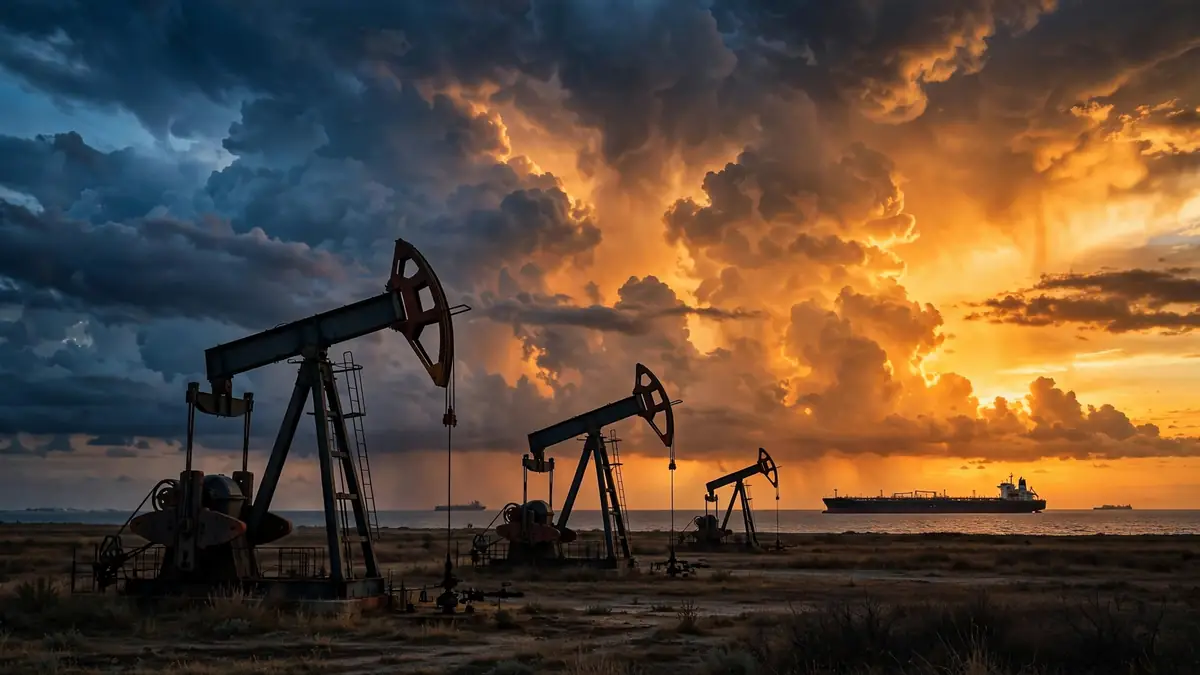
Oil at the center of everything
Follow the money in late September 2026 and almost every road leads back to oil. With Brent crude trading around $105 to $108 a barrel and tensions around Iran and the Strait of Hormuz unresolved, the energy shock has become the dominant force in global markets — pushing bond yields to multi-decade highs, squeezing businesses and households, and driving the Federal Reserve's first rate hike in more than three years.
The mechanics are brutally simple. Oil is an input into almost everything: transport, manufacturing, food production, and heating. When crude stays above $100 for weeks, those costs ripple through supply chains and eventually show up in consumer prices — the dreaded “second-round effects” that central bankers fear most.
The Strait of Hormuz pressure point
Roughly a fifth of the world's oil consumption passes through the Strait of Hormuz, the narrow waterway between Iran and Oman. When tensions flare around it, traders price in the risk of disruption — and prices move fast. The US-Iran standoff, which intensified after President Trump rejected deal talks over a September weekend, has kept that risk premium firmly in place.
Shipping markets tell the same story. Freight rates on key Asian-European routes have surged as carriers reroute and insurers raise premiums, adding another layer of cost to goods already pressured by fuel prices. For importers and exporters across Europe and Asia, the combination of expensive crude and expensive freight is a double hit to margins.
Bond markets sound the alarm
The most dramatic market signal has come from government bonds. The yield on the US 10-year Treasury touched 5.24% in late September — a 19-year high — before settling around 5.21%. In Britain, the 10-year gilt yield climbed to its highest level since 2007, hovering around 5.4%.
Rising bond yields matter for two reasons. First, they are the benchmark for borrowing costs everywhere: mortgages, corporate debt, and government financing all price off them. Second, they reflect what investors believe about inflation and policy — multi-decade highs in yields mean markets now expect elevated inflation and tighter central-bank policy to persist.
Equities have felt the squeeze. Major US indexes sank to open the week of September 28 as yields jumped, though futures stabilized the following morning. In London, the FTSE 100 managed a 0.34% gain to 10,721.48 on September 29 — lifted by pharmaceutical stocks after AstraZeneca agreed to take a $2 billion stake in Summit Therapeutics to advance cancer research — but the broader backdrop remained one of caution. Industrial metals rebounded with copper prices, miners Glencore and Anglo American added around 1.6-1.7%, and discount retailer Pepco rose after lifting its full-year profit forecast on a strong fourth quarter. Among the losers, British American Tobacco slipped 1.7% after warning annual growth would come in at the lower end of its forecast range.
Businesses feel the squeeze
For companies, the oil shock arrives through three channels: transport, energy, and financing. UK businesses started the final week of September facing a difficult combination of record diesel prices — 199.18 pence per litre, an all-time high — historically high borrowing costs, and continued geopolitical uncertainty, according to the Credit Protection Association's daily business briefing.
The pressure is showing up in corporate behavior. The Bank of England has grown increasingly alert to the risk that energy inflation becomes embedded in prices and wages. Business groups, including the CBI, have warned the government against further increasing the cost of hiring, investing, or doing business ahead of the Budget. The Insolvency Service, meanwhile, has stepped up action against abusive “phoenixing” — where directors dissolve indebted companies and restart them debt-free — as creditor losses mount.
Not all signals are negative. UK shop-price inflation eased to 1.4% in September, suggesting retailers are absorbing some higher costs rather than passing them straight to consumers. A new government first-time-buyer scheme triggered a rally in housebuilder shares, and Rolls-Royce announced £300 million of new UK investment. But for small and mid-sized firms selling on credit, the immediate issue remains cashflow: higher transport, energy, and financing costs erode both their own margins and their customers' ability to pay.
Households under strain
The human side of the shock is stark. UK household energy debt has reached a record £5.02 billion, highlighting the deterioration in payment resilience across the economy. With diesel at record prices and borrowing costs at multi-decade highs, consumers face the same triple squeeze as businesses — and they have less room to absorb it.
The labor market remains a source of resilience: post-pandemic employment has proved stronger than previously thought, and the US unemployment rate stood at 4.1% in August. But strong employment cuts both ways for policymakers — it gives central banks room to keep rates high without fearing an immediate jobs collapse, prolonging the pain for borrowers.
Safe havens shine
When uncertainty rises, money seeks safety — and the classic havens have responded. Gold futures climbed to $4,185 an ounce in late September as investors hedged against both geopolitical escalation and inflation. Bitcoin traded around $84,400, holding above recent lows. Cash-like instruments have also benefited: with short-term rates elevated, money market funds are offering yields that were unimaginable during the era of near-zero rates.
The Federal Reserve's September 16 rate hike — its first since July 2023, taking the target range to 3.75%–4.00% — was itself largely a response to the oil-driven inflation dynamic. With 16 of 19 policymakers expecting at least one more hike in 2026, the message from the world's most important central bank is that the energy shock will be fought with tighter money, whatever the cost to growth.
What comes next
Three variables will determine how this plays out. The first is geopolitics: any de-escalation around Iran and the Strait of Hormuz would drain the risk premium from oil prices quickly — but the trajectory has been toward escalation, not away from it. The second is the inflation data: if energy costs start feeding into wages and core prices, central banks will have little choice but to keep tightening. The third is demand: high prices are themselves a form of tightening, and there are signs — from easing shop-price inflation to weakening private-sector activity — that the economy is already absorbing the blow.
For businesses and investors, the prudent posture is defensive: stress-test cashflows against higher-for-longer energy and financing costs, lock in rates where possible, and watch the data rather than the headlines. The oil shock of 2026 may not be the 1970s replayed — but as any trader watching Brent at $108 will tell you, rhymes are close enough to hurt.
Sources