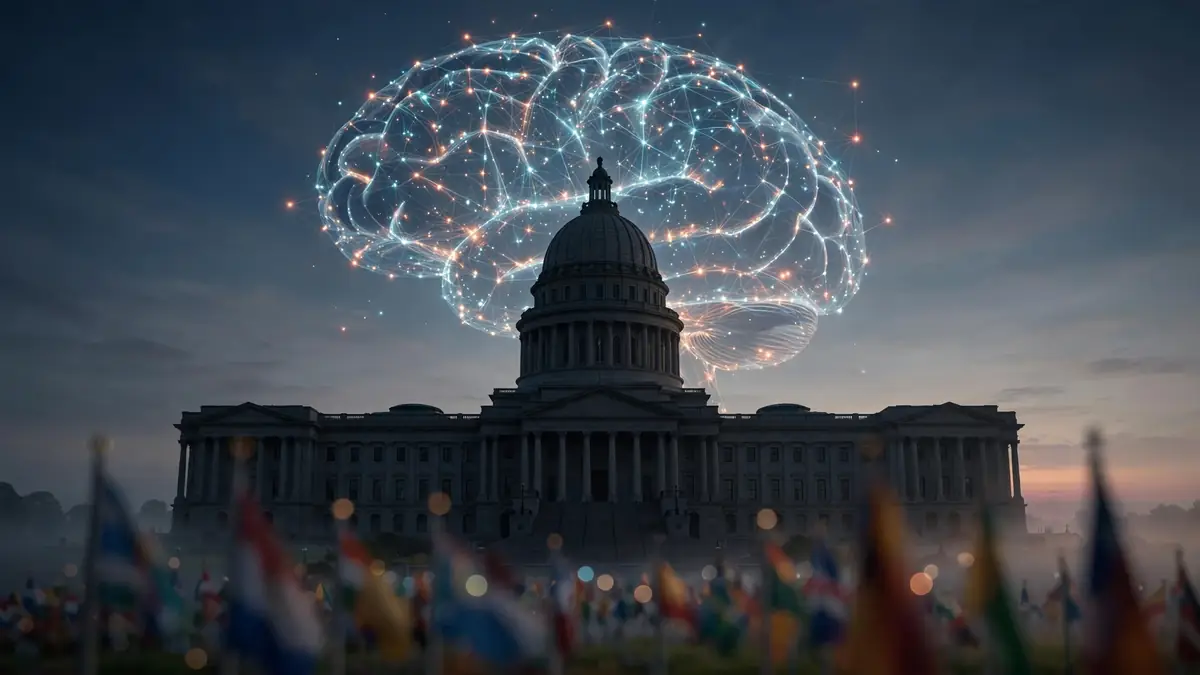
President Donald Trump announced on Monday, 29 September 2026, that he plans to sign an executive order officially renaming "artificial intelligence" as "super intelligence" in all United States government documents — a striking symbolic move delivered at the launch of America.gov, a new AI-powered website presented as a one-stop shop for federal services and information.
Speaking at the Andrew W. Mellon Auditorium in Washington, DC, Trump said the rebrand would be enacted later in the day and would apply to official government communications. The announcement came at the end of a day in which the president hosted the most powerful technology executives in the world at a White House lunch devoted to AI policy.
Why "super intelligence"
Trump has been road-testing the new terminology for more than a week. He teased it at the United Nations General Assembly, and he said he had raised it directly with Chinese leader Xi Jinping, who he claimed "seemed to like" the rebrand. (In his own public comments, Xi did not use the term "super intelligence.")
At the America.gov launch, Trump laid out his reasoning in blunt terms. The word "artificial," he argued, undersells what the technology actually is.
"This kind of innovation in government is just a preview of what is possible with super intelligence, or SI, and that's the official name in the United States. I'll be signing a very powerful executive order."
— President Donald Trump, at the launch of America.gov, 29 September 2026, reported by USA Today
"Because when you say artificial intelligence, it's artificial. This is extreme intelligence. It's superior intelligence. It's supreme also intelligence. But the word super is the best word of all and it's the simplest."
— President Donald Trump, reported by USA Today
According to The Associated Press, the State Department had already ordered diplomats in its international organisations bureau to use the term "super intelligence" — suggesting the rebrand was being seeded inside the administration before it was announced publicly.
The billionaires' lunch
Earlier the same day, Trump hosted a White House lunch in the East Room with a guest list that read like a roll call of the global AI industry: Meta's Mark Zuckerberg, Nvidia's Jensen Huang, SpaceX and X's Elon Musk, Google's Sundar Pichai, Amazon founder Jeff Bezos, Anthropic chief executive Dario Amodei, Palantir's Alex Karp, and OpenAI president Greg Brockman. Members of the cabinet and House Speaker Mike Johnson also attended.
Describing the gathering afterwards, Trump said there had been "an unbelievable feeling in this room" and that the executives "want to do the right things." He also made clear he has no appetite for the development slowdown that several of his guests have publicly advocated.
Amodei, who dined privately with Trump on Sunday night, has called for a deliberate slowdown of AI development after warnings from his former employee Jacob Coxon helped spark Democratic calls for regulation. Altman has issued a similar warning that companies lack adequate safeguards to control their most capable systems. Trump, by contrast, has rejected those calls — and used the lunch to endorse industry self-regulation instead.
"There's a belief that there should be tremendous self-regulation and we automatically have regulation with the Department of Justice, the FBI, all of that. But the self-regulation is very important."
— President Donald Trump at the White House AI lunch, reported by the New York Post
Trump added that the United States is leading the world in AI and intends to stay there: "We're leading, and we're going to keep it that way," he said, with the executives arrayed around him.
What the executive order would actually do
The rebrand would apply to terminology in official US government documents and communications — federal agencies, official reports, and diplomatic correspondence would refer to "super intelligence" rather than "artificial intelligence." Trump said he would sign the documents at around 5 p.m. on Monday.
Whether the new term travels beyond Washington is far from certain. Reporting on the announcement noted that there is no guarantee of wider adoption: researchers, companies, and international bodies are unlikely to abandon the established term simply because of a US executive order. Even within the industry, the reaction may be mixed — several of the executives at the lunch have built their companies' brands, products, and safety frameworks around the term "AI."
The symbolic weight of the move matters more than the vocabulary. By renaming the technology, the administration is framing it as a national strategic asset — something closer to a superpower to be stewarded than a commercial product to be regulated. That framing sits comfortably with Trump's rejection of a slowdown: if the technology is "super" rather than "artificial," slowing down looks less like prudence and more like unilateral disarmament.
America.gov: AI inside government
The rebrand was announced at the unveiling of America.gov, which the administration described as an AI-powered one-stop shop for accessing federal services and information. The site represents one of the most visible attempts yet to put AI systems directly between citizens and the state — and, fittingly, Trump presented it as a preview of what "super intelligence" could do across government.
The launch places the administration's AI posture in sharp relief. On one side: rapid deployment of AI inside the machinery of government itself. On the other: resistance to slowing the private-sector labs building the underlying models, coupled with a rhetorical upgrade that treats the technology as an instrument of national strength.
Why this matters beyond the name
For an international audience, three things about the day are worth taking seriously.
First, the rebrand signals how the Trump administration wants AI to be understood: not as a risky experiment requiring guardrails, but as a supremacy project. That framing has consequences for regulation — it is harder to argue for mandatory pauses on something the government has officially designated as "super."
Second, the White House is betting that self-regulation, backed by existing law enforcement, is sufficient. With OpenAI having just shelved a model launch on safety grounds and Anthropic's chief executive calling for a slowdown, the industry itself is visibly divided — and the president has picked the side that wants to keep moving fast.
Third, language shapes policy. Whatever the wider world calls it, a US government that officially speaks of "super intelligence" is a government preparing to compete — with China, with Europe, and with anyone else in the race — on the technology's most ambitious terms. Allies and rivals alike will be reading the executive order not for its vocabulary, but for its intent.
Sources